


 View Cart
 Search Our Site
 Products
 Knowledgebase
 Company Info
 Contact Us
 Help
HelpLongitudinal Imbalance Tech Bulletin
Longitudinal Imbalance (AC Voltage) : When you've tried EVERYTHING else...
Telephone companies have been dealing with AC on phone lines since they first started serving the same customers as the electric company, locating their lines on the same poles as the electric wires. Since phone lines are often built along the same route as power lines, varying amounts of AC voltage are easily induced onto the phone lines. This AC voltage usually can't be heard since it's traveling on balanced phone lines (where both sides of the line are exactly the same distance from the central office), called "common mode." The same amount of AC is on the tip as the ring, so you don't hear it in your Butt-set (that has no reference to ground). AC voltage can go as high as 50V before the phone company (in most states) has to do something to bring the voltage down - mainly for safety reasons (touching 50VAC with a sweaty arm could hurt!).
The farther a pair for a phone line travels parallel to a power line, whether it's on poles or underground (or buried in the same trench to a gate), the more AC will be induced onto the phone line. The more current that's being used on the power cable, the more AC will be induced onto a phone line running parallel to the power cable.
Induced AC voltage will be present on all of the lines in a cable. Whether you hear it depends upon the balance of the line. An unbalanced line will convert the induced AC to metallic voltage and current, which you hear as hum, buzz, crackling, etc.
If a phone line has AC on it, and it's perfectly balanced, you won't hear the AC on your Butt-set. When you connect a phone system or other electronic device that has a reference to ground (and is slightly unbalanced) to that same line, you'll start to hear hum.
When you do hear hum on the line, you are usually hearing a harmonic (multiple) of the original 60 cycles, since 60 cycles is too low to be heard on the telephone line.
The phone company has a number of solutions available to them when they have too much AC on a line with hum. They usually install a big inductor or choke (a really big and heavy transformer, sometimes called a "humbucker").
In the past, the only thing hanging off the phone line at the subscriber end was a single line phone or an electromechanical PBX that had simple relays that clunked open or closed. Noise and voltage problems had little effect on their operation. AC voltages of 5 or 50 volts didn't bother them much.
Modern phone systems use electronic components on the trunk cards. Some of these components cause a small imbalance on the line. This imbalance may not even cause a hum, but if there is a lot of AC voltage on the line, some AC potential is created. Now you've got this AC voltage traveling between the tip and ring, which is something that the electronic PBX or Key System may not be designed to deal with. This 5 or 20 VAC can have adverse effects on the system like lines that won't ring, false ringing, lock-ups, cut-offs, Caller ID problems, and who knows what. Even if the line is perfectly balanced, the electronics on the trunk cards can be stressed by the induced AC voltage on the line all the time.
Since the AC voltage on the line would be different at each premise having problems, the symptoms may be different even though the premises have the same exact system.
A common symptom of high induced AC on a phone line is when Caller ID is intermittent or doesn't work at all, but a cheap battery-operated Caller ID box works fine. The battery-operated Caller ID box has no reference to ground, so the induced AC stays common mode - exactly the same on the tip as the ring, and Caller ID works fine. When the phone system trunk port is connected, it's not perfectly balanced so there's now more AC on the tip or ring than the engineer designed the system to work at, and Caller ID might not work.
The engineers in third world countries who design modern phone systems don't even check to see if induced AC will cause a problem. The problems occur at comparatively few places, so today's phone system manufacturers don't want to put any money into making sure it's not a problem with their system (in other words - they don't know, and they don't care).
One of the factors that makes it tough to troubleshoot AC problems is that the AC that's induced onto the line may be different at different times of the day. If there's a big factory on the power line before or after it gets to the subscriber, and the phone line is running along the same route as the power line, you may see a large increase in the induced AC voltage when the factory is at peak operation (using peak power). Maybe the factory uses the most power in the morning, or the afternoon? That means that you may see strange intermittent problems at only certain times of the day. This is the worst kind of problem to troubleshoot, but if you know about induced AC and longitudinal imbalance you at least have some chance of fixing it. If you don't know about it, you're in trouble.
You'll sometimes hear hum on the trunk on the phone system when you have a longitudinal imbalance, but not all the time. It could be just strange stuff happening that could be the symptom.
The first step is to take a reading of the AC on the line by measuring from tip to ground, then ring to ground with an AC voltmeter. Because the phone equipment may have a center tapped transformer which could screw up your readings, you should open the line before taking your readings. When I measured our lines, they had about .5VAC (half a volt) from tip or ring to ground. I got the same voltage on both sides of the line. I measured it first on an idle line, and it read the same with the pair closed down and also when I went off hook.
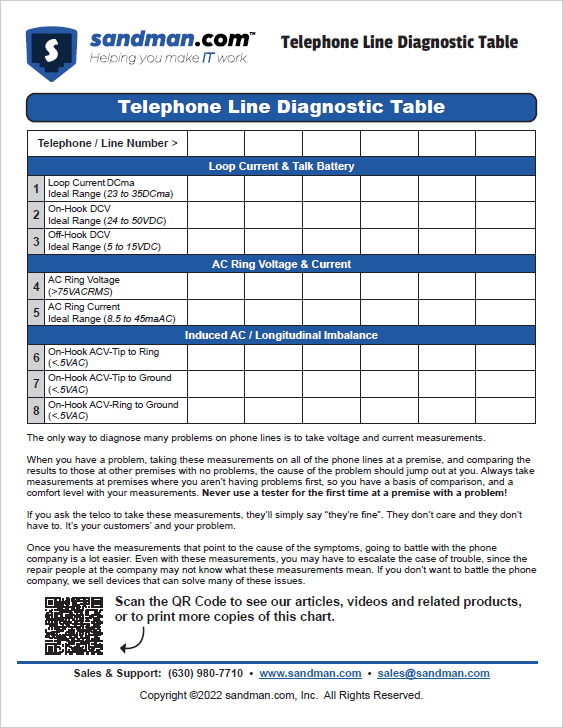
Note that some meters just won't read AC on a telephone line correctly, and there's no way to know whether a particular meter make/model will or won't until you try it. Most Fluke meters will work, but even expensive True RMS meters might not. Since you're measuring AC riding on-top of the DC talk battery, some cheap meters get confused. As soon as you put a meter like this on a phone line, on the AC scale, the readings will just hunt all over the place, never stopping, and never making any sense.
We also have a 14 minute training video showing how to take all of these readings.
If you have a telephone company type line tester, you can take a reading of the Circuit Noise and Power Influence. Personally, I've never used these being an Interconnect phone man. If I hear hum on the line at the demarc with the equipment disconnected, I just call the phone company and let them fix the problem out in the field. You should never hear hum or noise on a phone line at the demarc with the equipment disconnected, no matter what the phone company says!
Phone company guys use the Noise and Power Influence tests to tell them that there's a problem, and when they've fixed it. You may be able to use it just to give you a general idea of whether there is a problem on the line. There should be "green" areas on these types of meters, indicating the good range. Our lines had 47dbrnC on the Power Influence scale, and 1 to 2 dbrnC on the Circuit Noise scale - both in the "green" area.
You may be able to see if AC voltage is affecting the operation of a phone system or piece of equipment by running it on a Battery Backup unplugged from the wall, with any grounds removed from the system. When you do that the equipment has no reference to ground, and any AC on the phone line may no longer cause symptoms?
The only real way to tell if a longitudinal imbalance is causing problems on your phone system if you read over .5VAC is to put a device which isolates the AC voltage in front of the equipment, to see if the problem clears. There are two types of transformers that can help. The first is a choke, which uses the windings on a transformer to prevent AC voltage from getting to the phone system. The other is a drain, which drains the AC to ground. You may even need a combination of the two. According to the experts at SNC, about the only manufacturer of this kind of noise reduction equipment in the country, the only way to diagnose this is to put one of these devices on the line...to see if the trouble clears.
SNC has a gizmo they call the SNIX, which combines both the choke and drain in one case. They also have a tester called the Little Zapper which has a SNIX inside, that allows you to hook up the choke, drain or both using butt-set cords and clips. Once you determine that the hum is gone or the intermittent problems have stopped, you can put a choke, drain or SNIX (choke and drain combination) on the line. SNC's number is 800-558-3325, and they have engineers available to discuss your problem.
Longitudinal imbalance can occur after the NI too. I talked to a guy who ran some OPXs from a PBX over to a Merlin system, over 500 feet away. The Merlin system had some CO lines coming into it directly from the phone company, from a different direction than the PBX. Those lines worked perfectly and were hum free. The OPXs all had hum. As a matter of fact, when he swung an actual CO line into the Merlin using the same house pairs, he also had hum. If he used a 500 set or a butt-set, no hum. There was only hum when the line on the house pair was in the Merlin. Obviously, the Merlin had a slight imbalance which allowed the AC voltage that was picked up on the house pairs running through the plant to be heard as hum. This is the perfect scenario for using the Little Zapper to troubleshoot the problem.